A Fenno-Celtic Nativity
This Mythic short story is a mashup of Marjatta’s tale from Runo 50 of the Kalevala with Irish traditional stories of Brigid, taking in diverse other inspirations along the way.
The early-setting midwinter sun lit the clear western horizon ablaze, ushering in a new day. As the last of its light faded, the nineteenth flamekeeper arose from her post in the sacred fire temple, the light of the perpetual flames casting her shadow onto the soot-encrusted stone wall. Entreating the exalted one herself, this consecrated virgin employed the traditional formula: “Holy Brigid, our guardian, guide and companion, tend your own fire this night.” With those words she placed a final log on the flames, wrapped her heavy woollen cloak tightly around herself and stepped out through the northern door into the freezing night air, leaving the temple unattended.
Deep in that night, inhabiting this her sanctuary, brooding over the fluctuating flames, Brigid became aware of a distant soul, crying out for divine assistance:
     Tule, Luoja, turvakseni,
     avukseni, armollinen,
     näissä töissä työlähissä,
     ajoissa ani kovissa!
Come, Creator, my protector,
my most gracious trusted helper,
in these toughest throes of labour,
in this time of greatest struggle!
Attentive as always to the entreaty of those in need, Brigid questioned of the great spirit what circumstance might gave rise to this prayer. And so to her the story was revealed.
Far away, amidst the marshlands of the North, she perceived a young maiden, one determined to keep herself pure, set apart. Brigid observed the events that had befallen Marjatta, beloved youngest child of Hanna and mysterious Imran.
Ever a serious-minded girl, obsessively modest, Marjatta took great care to remain untainted. She was careful not to consume the eggs of hens where the cockerel had been. Neither would she eat mutton of the ewe had it been running with a ram. She refused to milk the cows, since they had cavorted with the bull.
“Sweet, silly girl,” Brigid mused, thinking of the sustenance and healing her own red-eared white cow provided to her and those in need. For it is not contact which defiles, but true purity comes from within.
Why had this girl been brought to her attention? Was she to be called from afar as a new postulant, to be initiated into these sacred rites? She may be young and naïve, but her heart and resolve were certainly admirable. With time she would surely mature to be a fine sister of the community. But no, that did not appear to be her fate; this was to be a calling of an altogether different nature.
Brigid observed as Marjatta led her family’s sheep out to pasture, watching over and caring for her lambs as they strayed. In a clearing, by the side of a pond, the girl heard a voice cry out: “Come, maiden, pluck and gather me. Chose me before the slug or worm devour me. For thousands have passed me by, but I have been overlooked.”
Curious as to the origin of this voice, she carefully approached its source. There she found a single cranberry, remaining in the bush, repeating its call. Eager for a closer look at the strangely demanding fruit, Marjatta hooked the branch with a stick, and pulled it to within sight.
The cunning berry, however, had plans other than conversation. Slipping from the branch, it seized its opportunity. It jumped upon her shoe, ascended her rustling skirts, past her belt, over her chest, rose to her chin and glided into her mouth. From there it rolled across her tongue, fell through her throat and dropped into her belly. By this errant cranberry, sweet Marjatta came to be with child.
As the weeks and months progressed, the perplexed young woman took to concealing the changes within her. She would go alone to sauna, apart from her family, and wore her clothing loosely to hide her situation. After all, there was no credible explanation of the peculiar circumstance which had befallen her.
But when the time came near for her to deliver her miraculous child, she could no longer hide her disposition. As much as she begged her mother and father for a safe place to deliver her baby, she was utterly rejected on the charge of impropriety. At her moment of need, Marjatta was cast out to find, alone, a place to bring forth the new life within her. It was in this moment that her cry for divine intervention had ascended.
That this pure one should be left in her distress would be intolerable, to give birth alone and in fear. Brigid resolved to intervene, to ease her pain. But the distance is long and time is short.
Remembering the loyal fox to whom she had given sanctuary, Brigid summoned him from his den amidst the roots of the majestic oak tree. She whispered her plan, entrusting him to arrange its execution. He ran off, full of purpose, and returned promptly, having gathered the required animal company, to transport Brigid on her journey. In a whirlwind of fur and spirit, the entourage sped away, the creatures delighted to repay the kindness and protection of their benefactor. The boar led the way, forging a path through the undergrowth.
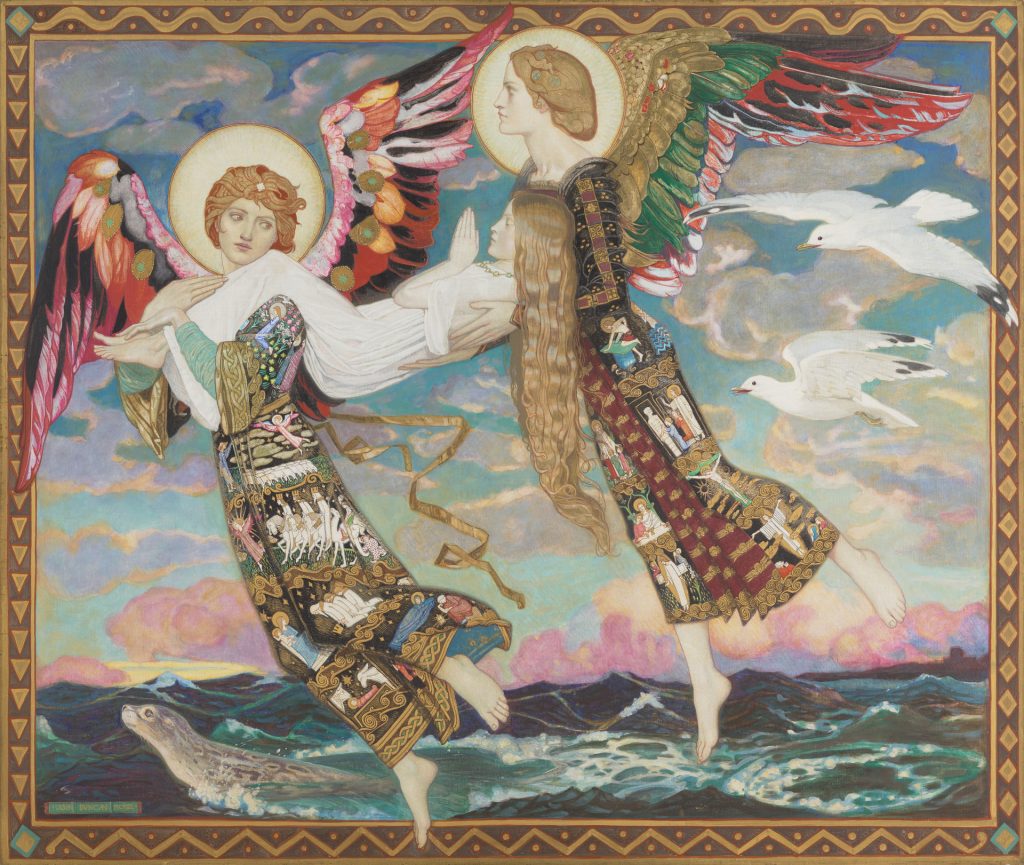
On reaching the coast, a second assembly took up the relay. Awaiting angels swept Brigid into the air upon brightly-coloured wings, surrounded by an escort of sea birds. The waters below teamed with life as seals and dolphins raced ahead. At great speed the distance was covered to the far shore, where another land team took charge. Less familiar than the first, this enlisted throng were no less dutiful in their care of their holy charge. Bear made a passage between the trees, while lynx and wolves flanked on either side.
Brigid was taken in haste directly to a horse’s stable, where she found poor Marjatta, lying exhausted upon the hay. Brigid set about making the expectant mother comfortable. Removing her own mantle, she wrapped it around Marjatta, bestowing its power of healing upon the mother, and blessing upon the one to be born beneath it.
For this child to be properly received into the world, the sauna warmth was needed, for which the mother’s request had been denied by her kin. Looking to the bemused resident of the stable, Brigid called out to the horse: “Good Finnhorse, noble suomenhevonen, your heat is needed. Breathe your warmth into this stable; fill this stall with the hot steam of your breath. Raise a sauna heat for Marjatta, so that she may deliver her child in comfort.”
The obliging horse breathed a cloud of vapour to envelope and soothe the mother, filling the stable with steam. Thus was Marjatta’s son brought into the world, under Brigid’s attentive care. This child of earth and verse was born upon the thresholds, bridging the human domain with those of the divine, nature and animal. Thus the old ways became entwined with a new emergent path, imbuing mundane reality with mythic richness.
Brigid addressed the new mother: “Concerning motherhood, I have little guidance to offer. But regarding incarnation, about that I know a thing or two of what your son will face. It is a rare and all-demanding call, to represent the divine presence for the people, to embody the immanent deity within the world. In that we are bound together. I will do all that is within my power to share this burden wherever I hold influence.”
Now in that region there were reindeer herders, guarding their animals by night. They watched amazed as the night sky was lit with brightly coloured, flickering tongues of light. Amidst the boreal display, they observed a single bright point descending to the earth nearby. Curious as to what had landed from the heavens, they left their herd and went in search.
In a narrow ravine they found the source of light, a curious being, wings crumpled beneath, head bleeding from striking the rock. Pity overcoming their terror, they hastened to bind the angel’s wounds. As she regained consciousness, they discerned the words “There is a new king of all Karelia, and lord of all who seek him. He has been born in that stable!”
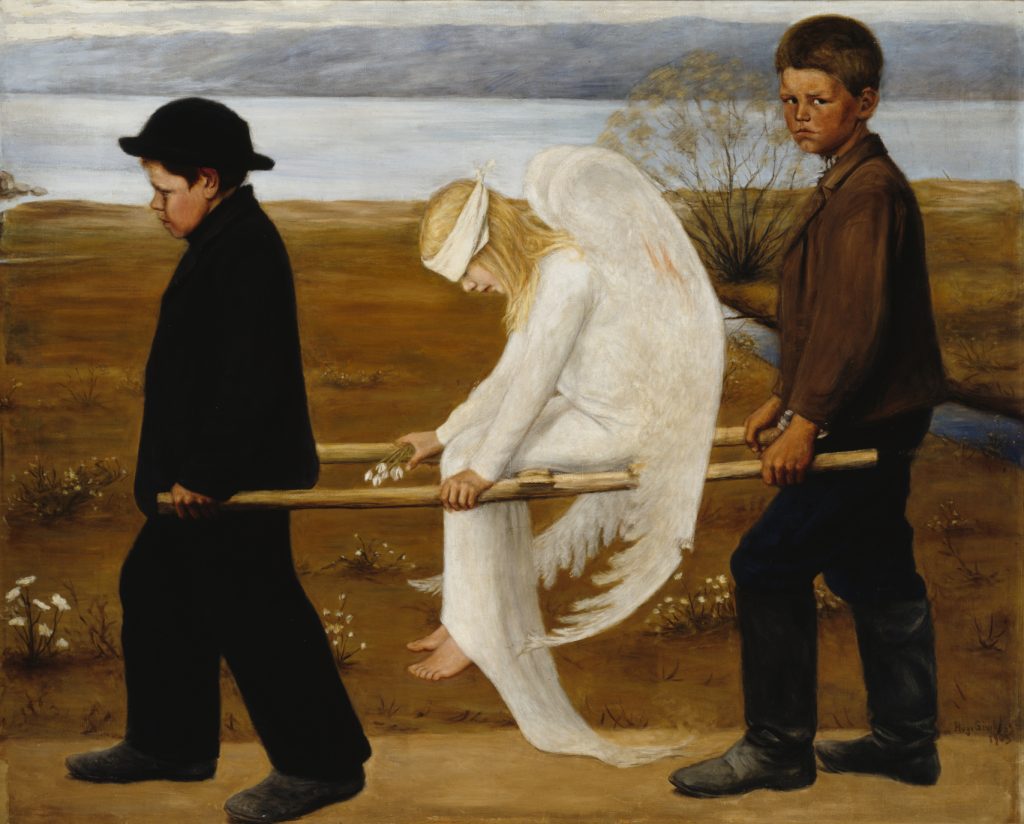
“She has a concussion, and is speaking some nonsense,” they concluded, “but the stable is nearby. Let us take her there for shelter.” Cobbling together a makeshift stretcher, between them they carried the injured messenger to the place where Marjatta and her newborn son rested in the horse’s warmth. There they were amazed by what they saw and told the new mother of the angel’s words.
Meanwhile, some shamans had also observed the lights in the sky from afar, and together discerned their meaning. Mounting their noble, enormous-antlered beasts, they set off to welcome the new king. In time they arrived at proud Ruotus’ mansion to enquire of the arrival.
“There is no other king in this land,” declared Ruotus, “but should you find such a one, report back to me.”
At nightfall, again following the source of the aurora’s fire, they came at last to the place where mother and child resided. Dismounting their moose, they entered, knelt down and presented their gifts of river-panned gold, milled flour and mineral salt. Marjatta pondered the meaning of these eclectic gifts in her heart.
Should she take this as a sign that the Sampo was once again active in the Northland? Did it remain in the keeping of the witch Louhi, or was this a foretelling that its fortunes and provision would return to Kalevala? These questions mingled with the enigmatic words spoken by Brigid and the angel regarding incarnation and kingship. And what had all this to do with her newborn son, this tiny baby sleeping in her arms, the one resulting from the berry’s alluring call?
Following the recuperating angel’s warning, the shamans did not report back to Ruotus, but returned home by another route. In time, as the new mother found her strength and confidence, Brigid too returned to her home in the west, taking with her the healing mantle which had shrouded the God-bearer. It would become a source of comfort, blessing and protection to generations of her people, and those whom her legend would touch.
Leave a Reply